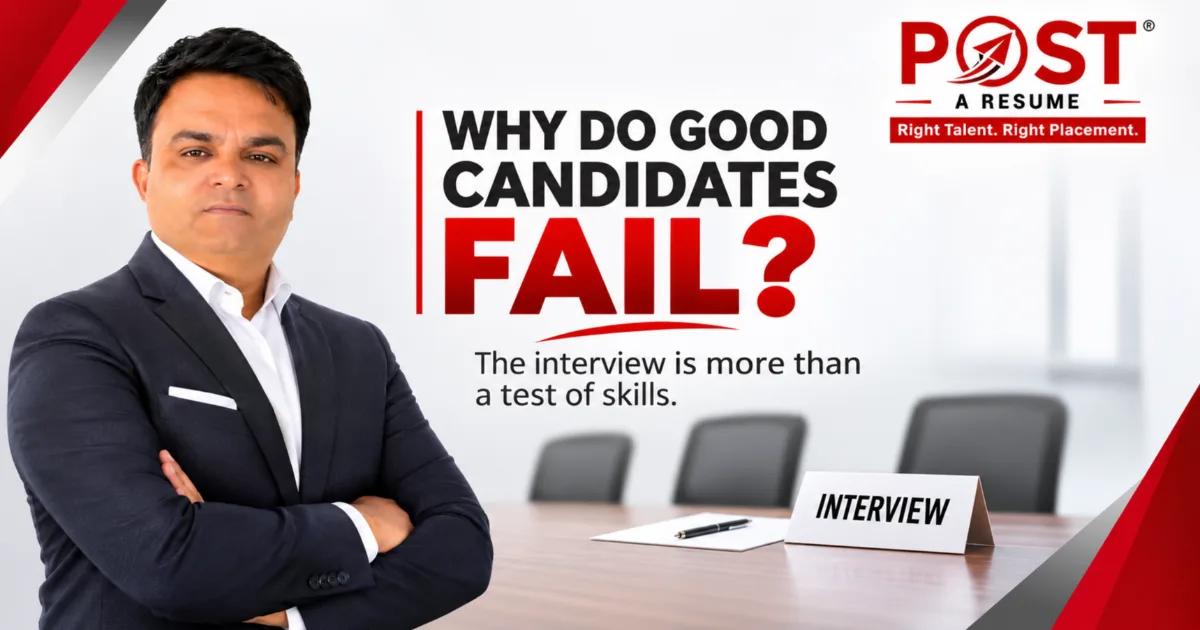
Why Do Good Candidates Fail Job Interviews? 10 Common Reasons Recruiters Notice
A candidate can have the right qualifications, years of experience and technical knowledge, yet still fail a job interview. Why does this happen?
One of the most interesting aspects of recruitment is that the best-qualified candidate does not always become the selected candidate.
Over the years, while working with organisations and professionals across different industries, I have observed that getting shortlisted for an interview and getting selected for a job are two very different things.
A resume may open the door, but an interview determines how effectively a candidate can demonstrate their knowledge, experience, attitude and suitability for the role.
So, why do good candidates fail job interviews?
Let's look at ten common reasons.
1. Lack of Interview Preparation
One of the most common mistakes candidates make is attending an interview without adequate preparation.
Some candidates know their technical subject very well but have not researched the organisation, its products, services, business model or expectations from the position.
Before attending an interview, candidates should understand:
-
The company's background and industry.
-
The job description and key responsibilities.
-
The skills required for the position.
-
The organisation's products, services and market presence.
-
The challenges associated with the role.
Preparation demonstrates genuine interest and helps candidates answer questions with greater confidence.
2. Poor Communication Skills
Having knowledge is important. Communicating that knowledge effectively is equally important.
A candidate may have excellent experience but struggle to explain their achievements, responsibilities or professional decisions.
Interviewers generally look for clarity, confidence and the ability to communicate ideas in a structured manner.
Candidates should practise explaining their experience in simple language, using relevant examples rather than lengthy explanations.
Remember, good communication is not about using impressive English or complicated words. It is about making your message clear.
3. Unable to Explain Their Achievements
Many candidates describe their responsibilities but fail to explain their actual contributions.
For example, saying:
"I was responsible for sales and business development."
is very different from explaining:
"I developed a new customer base, improved regional sales performance and contributed to business expansion."
Employers want to understand what candidates have achieved, what challenges they have handled and what value they can bring to the organisation.
Whenever possible, use measurable results, practical examples and specific achievements.
4. Lack of Confidence
Confidence plays an important role during interviews.
Some candidates know the answers but hesitate while responding. Others become nervous when asked unexpected questions.
This can create doubts about their ability to handle responsibilities, communicate with teams or manage challenging situations.
Confidence does not mean knowing every answer. It means being comfortable with your strengths, acknowledging your limitations and responding honestly.
5. Negative Attitude Towards Previous Employers
This is a significant concern for many interviewers.
When candidates constantly criticise their previous employers, managers or colleagues, it can create an impression of poor professionalism.
There may be genuine reasons for leaving an organisation. However, candidates should explain their reasons professionally.
Instead of focusing on complaints, talk about what you learned, what you are looking for in your next opportunity and how you want to grow.
Professional maturity is often reflected in how we speak about our past experiences.
6. Inability to Demonstrate Problem-Solving Skills
Organisations do not hire people only to perform routine activities. They hire people to solve problems and contribute to business results.
This becomes particularly important when recruiting middle and senior management professionals.
Interviewers may ask questions about difficult situations, business challenges, team conflicts, operational problems or customer issues.
Candidates should be prepared to explain:
-
What was the challenge?
-
What action did they take?
-
Why did they choose that approach?
-
What was the final outcome?
Practical examples are often more convincing than theoretical answers.
7. Mismatch Between Experience and Job Requirements
Sometimes, candidates fail because their experience does not match the actual requirements of the position.
A candidate may have 15 years of experience, but the employer may be looking for someone with specific industry exposure, leadership capabilities, technical expertise or experience managing a particular business function.
Experience alone does not guarantee suitability.
Candidates should understand the job requirements and highlight relevant experience instead of discussing everything they have done throughout their careers.
8. Unrealistic Salary Expectations
Compensation is an important part of every recruitment process.
However, candidates sometimes enter salary discussions without understanding the market, the role's responsibilities or the organisation's compensation structure.
A significant gap between salary expectations and the employer's budget can affect the selection process.
Candidates should research market compensation, understand their value and communicate their expectations realistically.
Salary discussions should be professional, transparent and based on mutual understanding.
9. Poor Listening Skills
An interview is not a presentation where candidates simply speak about themselves.
It is a conversation.
Some candidates are so focused on giving prepared answers that they fail to listen carefully to the interviewer's questions.
As a result, they may provide irrelevant answers or miss important details.
Good listening demonstrates patience, emotional intelligence and the ability to understand situations before responding.
Listen carefully, understand the question and then answer.
10. Lack of Clarity About Career Goals
Interviewers often want to understand why a candidate is looking for a change and what they expect from their next role.
Candidates who cannot explain their career direction may appear uncertain about their professional priorities.
It is important to understand:
-
Why do you want to change your current job?
-
What are you looking for in your next organisation?
-
What kind of responsibilities interest you?
-
How does this opportunity fit your long-term career plans?
Clear career goals help employers understand whether the opportunity is suitable for both sides.
What Can Candidates Do to Improve Their Interview Performance?
Interview success is not always about having more qualifications or experience. Often, it is about presenting existing capabilities more effectively.
Here are five practical suggestions:
-
Prepare thoroughly: Research the company, understand the job description and prepare relevant examples.
-
Know your resume: Be ready to explain every important experience, achievement and career transition mentioned in your resume.
-
Practise your answers: Prepare for common interview questions, but avoid memorising scripted responses.
-
Demonstrate the right attitude: Be professional, positive, honest and open to learning.
-
Ask meaningful questions: Show genuine interest in the organisation, team, expectations and responsibilities.
A Message for Employers and Hiring Managers
While candidates must prepare for interviews, organisations also have a responsibility to make the selection process effective.
A good candidate may not always perform perfectly in a traditional interview setting.
Hiring managers should look beyond first impressions and evaluate candidates on relevant skills, practical experience, problem-solving ability, attitude and potential.
Structured interviews, competency-based questions, practical assessments and consistent evaluation criteria can help organisations make better hiring decisions.
The objective should not be to find someone who gives perfect answers. It should be to identify someone who can perform, contribute and grow with the organisation.
Final Thoughts: An Interview Is More Than a Test of Skills
In recruitment, I strongly believe that the right hiring decision comes from evaluating the complete candidate.
Technical knowledge may help someone qualify for an interview. But communication, attitude, preparation, problem-solving ability and professional maturity can influence the final decision.
For candidates, every interview is an opportunity to demonstrate not just what they know, but what they can contribute.
For employers, every interview is an opportunity to identify talent that can create long-term value.
A good candidate does not always fail because of a lack of capability. Sometimes, they fail because they are unable to demonstrate that capability effectively.
The real question is:
Are you preparing to attend an interview, or preparing to demonstrate why you are the right person for the job?
About the Author
Vipul M. Mali is the Founder and Business Head of POST A RESUME HR Consultancy, with 19 years of entrepreneurial experience in recruitment and HR consulting. He specialises in mid and senior management recruitment, technical and engineering hiring, and talent acquisition across India, the Gulf and Africa.
He also hosts Expert Talk Show by Vipul The Wonderful, where professionals share their experiences, insights and career journeys.
Connect with Vipul M. Mali and POST A RESUME for recruitment insights, career guidance and hiring solutions.
#InterviewTips #JobInterview #CareerGrowth #Recruitment #HiringStrategy