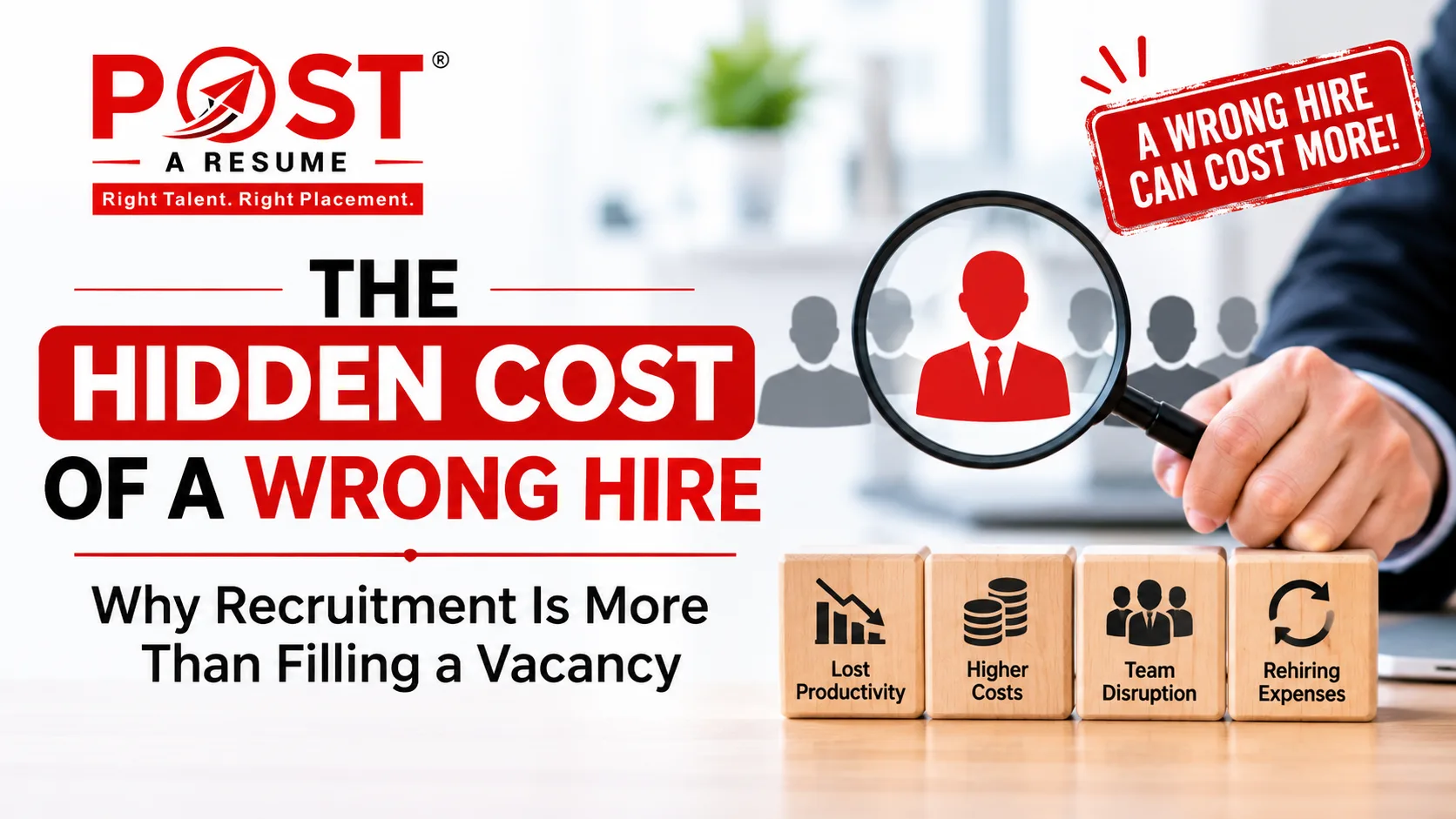
The Hidden Cost of a Wrong Hire: Why Recruitment Is More Than Filling a Vacancy
A bad hiring decision can cost an organisation far more than the employee's salary. From lost productivity and team disruption to repeated recruitment expenses, the consequences of hiring the wrong person can affect business performance long after the employee leaves.
Hiring is one of the most important decisions a business makes.
When a company has an open position, the immediate priority is often to fill the vacancy as quickly as possible. Teams may be stretched, projects delayed, and managers under pressure to find someone who can join immediately.
But in the rush to fill a position, organisations sometimes overlook a critical question:
Are we hiring the right person, or simply hiring someone to fill the vacancy?
A candidate may appear suitable during an interview, possess impressive qualifications, and have several years of experience. Yet, after joining, the individual may struggle with the responsibilities, expectations, organisational culture, or technical requirements of the role.
The consequences of a wrong hire can extend far beyond the recruitment process.
It can affect productivity, employee morale, customer relationships, business operations, and ultimately, the organisation's growth.
Let's understand why hiring the wrong candidate can be expensive and how businesses can make better recruitment decisions.
1. Recruitment Costs Do Not End With Hiring
Many organisations calculate recruitment costs based on the expenses involved in sourcing and selecting a candidate.
These may include:
-
Recruitment consultancy fees.
-
Job portal subscriptions.
-
Advertising expenses.
-
HR team time.
-
Interviewing and assessment costs.
-
Background verification expenses.
However, the actual cost of hiring becomes significantly more complicated when the selected candidate does not perform as expected.
The organisation may need to restart the entire recruitment process, while also managing the consequences of the unsuccessful appointment.
This means the original recruitment investment may not deliver the expected return.
The business must now spend additional time, money, and resources to find another candidate.
2. Lost Productivity and Business Performance
Every employee is hired to contribute towards specific business objectives.
When the wrong candidate joins, the expected contribution may not materialise.
For example, a Production Manager hired to improve manufacturing efficiency may struggle to manage production planning, coordinate teams, or resolve operational challenges.
Similarly, an experienced Sales Manager may fail to achieve expected targets because their previous experience does not align with the company's products, customer base, or sales strategy.
The consequences may include:
-
Delayed projects.
-
Missed business targets.
-
Reduced operational efficiency.
-
Increased workload for other employees.
-
Additional supervision and training requirements.
The longer the mismatch continues, the greater its potential impact on business performance.
3. The Impact on Existing Employees
A wrong hiring decision rarely affects only the individual who was hired.
Existing employees may need to compensate for the new employee's shortcomings.
Managers may spend additional time correcting mistakes, providing guidance, or taking over responsibilities that were expected to be handled independently.
This can create frustration within teams, particularly when employees already have demanding workloads.
Over time, the situation may affect:
-
Employee morale.
-
Team productivity.
-
Workplace relationships.
-
Motivation and engagement.
-
Retention of high-performing employees.
A recruitment decision intended to strengthen a team can sometimes create additional pressure for the very employees it was supposed to support.
4. Hiring the Wrong Senior-Level Professional Can Be Even More Expensive
The impact of an unsuitable hire can become more significant when the position involves leadership, strategic decision-making, or critical business responsibilities.
Senior professionals often influence multiple departments, teams, projects, and business objectives.
An unsuitable leadership appointment may result in:
-
Poor strategic decisions.
-
Ineffective team management.
-
Increased employee turnover.
-
Delayed expansion plans.
-
Operational inefficiencies.
-
Loss of business opportunities.
For example, hiring an experienced Plant Head without adequately evaluating their knowledge of the company's manufacturing processes may create operational challenges.
Similarly, an International Sales Manager with experience in a different market may struggle to develop the company's export business if the candidate's previous exposure does not align with the organisation's target markets.
A senior-level hiring decision should be based on more than designation, years of experience, or an impressive resume.
The candidate's actual responsibilities, achievements, leadership style, industry knowledge, and ability to deliver results must be carefully evaluated.
5. Recruitment Mistakes Can Affect Customer Relationships
Employees in sales, customer service, operations, and leadership positions often interact directly or indirectly with customers.
An unsuitable hire may affect service quality, communication, delivery timelines, or customer satisfaction.
For example, a Sales Manager who cannot effectively manage client relationships may negatively impact business development.
A technical professional who lacks the necessary expertise may create delays in project delivery or customer support.
In industries where customer relationships are built over several years, the impact of a wrong hiring decision may extend beyond a single transaction.
Business reputation and customer trust are valuable assets. Recruitment decisions can influence both.
6. Why Do Companies Make the Wrong Hiring Decisions?
Wrong hiring decisions do not always happen because recruiters fail to identify suitable candidates.
Sometimes, the recruitment process itself creates conditions that increase the likelihood of a mismatch.
Hiring in a Hurry
When a vacancy becomes urgent, organisations may reduce the time spent on candidate evaluation.
Interview processes may become shorter, reference checks may be overlooked, and hiring managers may prioritise immediate availability over suitability.
While filling vacancies quickly is important, speed should not replace proper assessment.
Unclear Job Requirements
If the employer has not clearly defined the responsibilities, expectations, reporting structure, and required competencies, recruiters may struggle to identify the right candidate.
Candidates may also misunderstand the position, leading to mismatched expectations after joining.
A well-defined job description is an important starting point for successful recruitment.
Overreliance on Resume Keywords
A resume may contain the right skills, designations, and industry terminology.
However, these details do not necessarily establish the depth of a candidate's expertise.
Recruiters and hiring managers should explore how candidates have actually applied their knowledge, handled challenges, and delivered results.
Interview Bias
Hiring decisions can sometimes be influenced by personal impressions, communication style, educational background, or similarities between the interviewer and candidate.
A structured interview process with role-specific questions and consistent evaluation criteria can help reduce subjective decision-making.
Ignoring Cultural and Organisational Fit
Technical expertise is important, but candidates must also be able to work effectively within the organisation's environment.
A professional who performs well in a large multinational organisation may have a different working style from someone who thrives in a growing family-owned business or a fast-paced startup.
Understanding the organisation's expectations, culture, structure, and working environment can help identify candidates who are more likely to succeed.
7. How Businesses Can Reduce the Risk of a Wrong Hire
Hiring decisions will never be completely risk-free. However, organisations can improve the quality of their recruitment process through a more structured approach.
1. Define the Role Clearly
Before beginning recruitment, identify the actual responsibilities, essential skills, qualifications, experience, and performance expectations.
The hiring team should understand what success in the role looks like.
2. Evaluate Relevant Experience
Do not rely solely on years of experience or previous job titles.
Assess the candidate's responsibilities, achievements, industry exposure, and relevance to the position.
3. Conduct Structured Interviews
Prepare questions based on the job requirements.
Ask candidates to explain real situations they have handled, decisions they have made, and challenges they have overcome.
This can provide better insight into their capabilities than generic interview questions.
4. Verify Important Information
Where appropriate, conduct professional reference checks and background verification.
These processes can help validate employment history, qualifications, and relevant professional information.
5. Assess Technical and Functional Competencies
For specialised positions, practical assessments or role-specific discussions may help evaluate a candidate's actual capabilities.
This is particularly important when hiring for technical, engineering, manufacturing, pharmaceutical, finance, IT, and leadership positions.
6. Understand Candidate Expectations
Salary expectations, career objectives, location preferences, notice periods, and willingness to relocate should be discussed early in the recruitment process.
Clear communication can help reduce mismatches after the offer stage.
7. Focus on Quality of Hire
Recruitment success should not be measured only by how quickly a vacancy is filled.
Organisations should also consider whether the employee performs effectively, integrates into the team, and contributes to the expected business objectives.
8. The Role of Recruitment Consultants in Reducing Hiring Risks
Recruitment consultants can help businesses make more informed hiring decisions by bringing market knowledge, candidate networks, and structured recruitment expertise to the process.
An experienced recruitment partner can support organisations in several ways.
Understanding the Actual Hiring Requirement
Recruitment begins with understanding the employer's expectations, business requirements, and the responsibilities associated with the position.
This helps recruiters identify candidates whose profiles are genuinely relevant rather than simply matching keywords in a job description.
Identifying Relevant Talent
Recruitment consultants can use targeted sourcing strategies, professional networks, databases, and referrals to identify suitable candidates.
This can be particularly useful when hiring for specialised or mid-senior management positions.
Evaluating Candidate Profiles
A recruitment consultant can assess professional experience, career progression, industry exposure, relevant skills, and candidate expectations before presenting profiles to the employer.
This helps hiring managers focus on candidates who are more aligned with the role.
Supporting the Hiring Process
Recruitment consultants can assist with candidate communication, interview coordination, feedback, salary discussions, and offer follow-ups.
A structured process can improve the overall recruitment experience for both employers and candidates.
Providing Market Insights
Recruitment partners can also help employers understand talent availability, salary expectations, industry hiring trends, and the challenges associated with specific positions.
This information can support more realistic recruitment strategies.
Recruitment Is an Investment, Not Just an Expense
Businesses often view recruitment as a cost associated with filling vacancies.
However, hiring the right professional can create long-term value for an organisation.
A suitable employee can improve productivity, strengthen teams, contribute to business growth, enhance customer relationships, and support operational efficiency.
The value of a successful hiring decision may continue long after the recruitment process is completed.
On the other hand, an unsuitable appointment can create costs that are difficult to calculate precisely.
This is why organisations should focus on the quality of recruitment rather than simply the number of positions filled or the speed of hiring.
Final Thoughts: The Right Hire Can Change the Business
Every recruitment decision has the potential to influence an organisation's performance.
Hiring the wrong candidate can result in lost time, additional expenses, operational challenges, and disruption to existing teams.
But hiring the right professional can strengthen the organisation, improve productivity, and support long-term growth.
The objective should not simply be to fill a vacancy as quickly as possible.
It should be to identify someone whose skills, experience, expectations, and capabilities align with the organisation's requirements.
Because the cost of a wrong hire may be significant, but the value of the right hire can be transformative.
At Post A Resume, we believe successful recruitment begins with understanding the employer's requirements and identifying the right talent for the right position.
Since 2007, we have supported recruitment requirements across India and international markets, helping organisations identify professionals across industries and functions.
Whether you are hiring for a specialised technical role, mid-senior management position, or executive-level requirement, the right recruitment approach can make a meaningful difference.
Are You Hiring for an Important Position?
Connect with Post A Resume to discuss your recruitment requirements.
Website: https://postaresume.co.in/
Connect with Post A Resume: