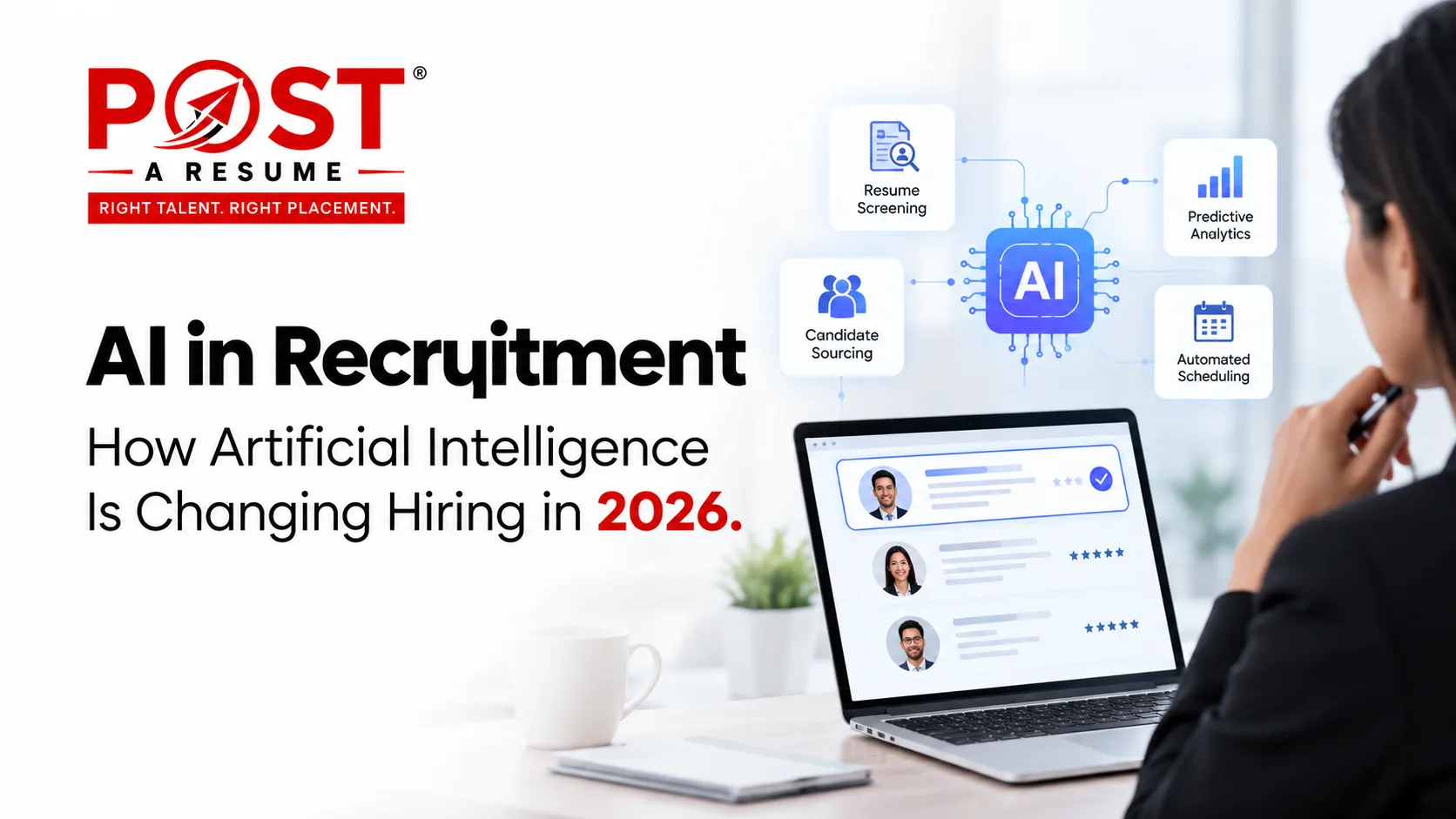
AI in Recruitment: How Artificial Intelligence Is Changing Hiring in 2026
Recruitment is evolving rapidly. What once required hours of manual resume screening, candidate searches, and interview coordination can now be supported by artificial intelligence.
AI in Recruitment: How Artificial Intelligence Is Changing Hiring in 2026
Recruitment is evolving rapidly. What once required hours of manual resume screening, candidate searches, and interview coordination can now be supported by artificial intelligence.
From AI-powered resume screening to automated candidate sourcing and predictive hiring analytics, technology is changing how organisations identify, evaluate, and hire talent.
But does AI make recruitment better? Can artificial intelligence replace recruiters? And how can businesses use AI in recruitment without losing the human element of hiring?
In 2026, these questions are becoming increasingly important for HR professionals, recruitment agencies, hiring managers, and business leaders.
Let's explore how AI is transforming recruitment, its major benefits and limitations, and what organisations should consider when adopting AI-powered hiring solutions.
What Is AI in Recruitment?
AI in recruitment refers to the use of artificial intelligence technologies to support and improve different stages of the hiring process.
These technologies can analyse information, identify patterns, generate content, and automate repetitive tasks that traditionally require manual effort.
Recruitment teams may use AI-powered tools for:
-
Resume screening and candidate matching
-
Job description creation and optimisation
-
Candidate sourcing and talent discovery
-
Interview scheduling and communication
-
Recruitment analytics and reporting
-
Candidate engagement and frequently asked questions
For example, an AI-assisted recruitment system can compare a candidate's stated skills and experience with a job description, helping recruiters identify profiles that may deserve closer review.
However, AI-generated recommendations are not definitive hiring decisions. Recruiters still need to verify relevant experience, assess suitability, and apply professional judgement.
1. AI-Powered Resume Screening
One of the most widely discussed applications of AI in recruitment is resume screening.
When a vacancy attracts hundreds of applications, manually reviewing every resume can consume considerable time. AI-assisted tools can help organise applications and identify information relevant to the role.
These systems may help recruiters identify:
-
Relevant technical and professional skills
-
Experience related to the job requirements
-
Relevant qualifications and certifications
-
Evidence of specific responsibilities or achievements
-
Potential matches between candidate profiles and open positions
The objective is to reduce repetitive work and help recruiters focus their attention on potentially suitable candidates.
The challenge: Resume screening tools can overlook qualified applicants when their experience is described differently from the wording used in a job description. Poorly designed systems may also reproduce historical biases or disadvantage certain groups.
Recruiters should use AI as a screening aid rather than relying exclusively on automated rankings or scores.
2. AI in Candidate Sourcing
Finding qualified candidates is often one of the most time-consuming parts of recruitment, especially for niche, technical, and senior-level positions.
AI-powered sourcing tools can help recruiters search large candidate databases, identify relevant skills, and discover professionals whose profiles align with a hiring requirement.
For example, a recruiter hiring a Design Engineer may need to identify candidates with experience in electrical equipment, transformer design, relevant engineering software, and manufacturing environments.
AI-assisted sourcing can help narrow the search by identifying relevant combinations of skills and experience.
However, recruiters must still verify the accuracy of candidate information, confirm interest in the opportunity, and assess whether the candidate meets the employer's actual requirements.
AI can help identify potential talent. It cannot independently establish whether someone is interested, available, or genuinely suitable for a particular workplace.
3. Generative AI for Job Descriptions and Recruitment Content
Generative AI has made it easier for recruitment teams to create and refine job descriptions, outreach messages, interview questions, and recruitment marketing content.
Instead of drafting every document from scratch, recruiters can use AI to produce an initial version and then customise it according to the role and employer.
Common applications include:
-
Writing clear and structured job descriptions
-
Improving the readability of job advertisements
-
Drafting candidate outreach messages
-
Creating role-specific interview questions
-
Preparing hiring updates and recruitment reports
For example, a lengthy job description can be converted into a concise, readable vacancy announcement that highlights the position's responsibilities, location, experience requirements, and essential skills.
However, AI-generated content must be reviewed before publication. Incorrect requirements, unrealistic expectations, misleading claims, or unclear language can create confusion for candidates and hiring managers.
The best approach is to combine AI's drafting capabilities with a recruiter's understanding of the role.
4. Recruitment Automation and Chatbots
Recruitment involves numerous repetitive activities, including application acknowledgements, interview reminders, status updates, and responses to common candidate questions.
Recruitment automation can help streamline these tasks.
AI-powered chatbots may answer frequently asked questions about application processes, job requirements, or interview schedules. Workflow automation can also help send reminders and organise candidate information.
These applications can improve response times and reduce administrative workloads.
However, candidates should have a clear way to contact a human recruiter when their situation requires individual attention.
A chatbot may be useful for answering a routine question, but it should not become a barrier between a candidate and the recruitment team.
Candidate experience still matters. Timely communication, transparency, and respectful interactions remain essential, regardless of how much technology an organisation adopts.
5. AI in Interviewing and Candidate Assessment
AI can support interview preparation and assessment by helping recruiters develop structured questions, organise evaluation criteria, and summarise interview notes.
For example, a recruiter hiring for a Business Development Executive position could use AI to prepare questions about lead generation, client acquisition, negotiation, and sales pipeline management.
The recruiter can then evaluate candidates against consistent, job-related criteria.
Some platforms also offer automated interview analysis or candidate scoring. These applications require particular care because automated systems may draw unreliable conclusions from speech patterns, facial expressions, or other indirect signals.
Organisations should avoid treating such outputs as objective measures of competence without strong evidence of validity and relevance.
A fair assessment process should focus on demonstrable skills, relevant experience, and job-related performance.
Human oversight is especially important when technology influences decisions that could affect a candidate's employment opportunities.
6. Predictive Analytics in Recruitment
Recruitment analytics helps organisations understand how their hiring processes perform.
AI-supported analytics may help identify patterns in:
-
Time to hire
-
Recruitment source effectiveness
-
Application-to-interview conversion rates
-
Interview-to-offer conversion rates
-
Offer acceptance rates
-
Recruitment costs
These insights can help hiring teams identify bottlenecks and make better-informed decisions.
For example, if a large number of candidates are screened but very few reach the interview stage, recruiters may need to review the sourcing strategy, job requirements, or screening criteria.
However, predictive analytics should be interpreted carefully. Historical hiring data can contain biases, and past patterns do not necessarily predict future performance.
Recruitment metrics are most useful when they support investigation and improvement rather than replace human judgement.
Benefits of AI in Recruitment
When implemented appropriately, AI can offer several advantages to recruitment teams.
Faster Recruitment Workflows
Automating repetitive tasks can help recruiters spend less time on administrative activities and more time engaging with candidates and hiring managers.
Improved Recruitment Productivity
AI-assisted sourcing, content creation, and data organisation can help recruiters manage multiple vacancies more efficiently.
More Consistent Processes
Structured templates and standardised evaluation criteria can help recruitment teams apply more consistent processes across candidates.
Better Use of Recruitment Data
Analytics can help organisations identify process inefficiencies, evaluate sourcing channels, and understand where candidates drop out of the hiring funnel.
More Time for Human Interaction
By reducing repetitive work, AI can create more opportunities for meaningful conversations with candidates and hiring managers.
These benefits are not automatic. They depend on the quality of the tools, the accuracy of the underlying data, the recruitment team's expertise, and the way the technology is implemented.
Challenges of Using AI in Recruitment
Despite its potential, AI in recruitment comes with important limitations.
1. Algorithmic Bias
AI systems can reproduce patterns present in historical hiring data. If those patterns reflect unfair preferences or past discrimination, automated recommendations may continue them.
Organisations should evaluate their tools for potential bias and monitor outcomes across relevant candidate groups.
2. Data Privacy and Security
Recruitment involves sensitive personal information, including resumes, contact details, employment history, and sometimes assessment results.
Employers should understand how recruitment platforms collect, process, store, and share candidate data. They should also avoid uploading confidential candidate information into unapproved AI tools.
3. Inaccurate AI Outputs
AI can generate incorrect summaries, misinterpret a candidate's experience, or make recommendations based on incomplete information.
Recruiters must verify important details rather than accepting generated content or assessments without review.
4. Reduced Human Connection
An overly automated recruitment process can make candidates feel ignored or treated as data points rather than individuals.
Personal communication remains important when discussing career goals, compensation expectations, relocation, notice periods, and other individual circumstances.
5. Overdependence on Technology
AI cannot compensate for unclear hiring requirements, unrealistic expectations, poor communication with hiring managers, or a weak recruitment strategy.
Technology works best when the underlying hiring process is already well designed.
Will AI Replace Recruiters in 2026?
AI is likely to automate or change some recruitment tasks, but recruitment involves much more than processing resumes.
Recruiters interpret hiring requirements, build relationships with candidates, understand client expectations, manage competing priorities, negotiate offers, and navigate complex employment decisions.
These responsibilities require context, communication, judgement, and trust.
A recruiter may use AI to identify potential candidates faster, but still needs to determine whether their experience genuinely matches the role, whether their expectations align with the opportunity, and whether the hiring manager should proceed.
The more practical question is not whether AI will replace every recruiter. It is how recruiters can use AI to improve their productivity while strengthening the human skills that make recruitment effective.
Recruiters who understand both recruitment fundamentals and relevant AI tools may be better positioned to adapt as hiring practices evolve.
How Recruitment Agencies Can Use AI Effectively
Recruitment agencies can begin by identifying repetitive activities that consume significant time without requiring complex human judgement.
A practical adoption strategy includes the following steps:
Step 1: Identify workflow bottlenecks. Review where recruiters spend the most time, such as resume searches, job description preparation, candidate updates, and reporting.
Step 2: Choose tools for specific problems. Avoid adopting AI simply because it is trending. Select tools that address clear recruitment needs and fit existing workflows.
Step 3: Start with lower-risk applications. Consider drafting job descriptions, organising non-sensitive information, or preparing recruitment reports before introducing AI into consequential candidate evaluations.
Step 4: Establish human review. Require recruiters to verify AI-generated summaries, recommendations, and communications before acting on them.
Step 5: Protect candidate data. Use approved platforms, limit access to sensitive information, and follow applicable privacy and employment requirements.
Step 6: Measure results. Compare productivity, accuracy, candidate experience, and process quality before and after implementation.
The aim should be better recruitment outcomes, not simply greater automation.
The Future of Recruitment: AI and Human Intelligence Working Together
The future of recruitment will likely involve a combination of automation, data-driven insights, and human decision-making.
AI can help recruiters process information, identify potential matches, and manage repetitive tasks. Recruiters bring the context, professional judgement, communication, and relationship-building needed to turn those possibilities into effective hiring decisions.
Organisations that adopt AI responsibly can improve efficiency while maintaining fairness, accountability, and candidate trust.
The most successful recruitment teams will not necessarily be those using the greatest number of AI tools. They will be those that understand where technology adds value, where human involvement is essential, and how to balance the two.
How Post A Resume Approaches Modern Recruitment
At Post A Resume, recruitment is about connecting businesses with talent that aligns with their hiring requirements.
As a recruitment firm serving India and international markets, Post A Resume supports employers across professional and specialised hiring needs.
Technology can support different stages of recruitment, but successful hiring still depends on understanding the role, evaluating relevant experience, communicating effectively, and identifying the right fit for the organisation.
For businesses looking to strengthen their recruitment efforts, visit the Post A Resume website.
Follow Post A Resume for recruitment insights, hiring updates, and career-related content:
Final Thoughts
AI is changing recruitment by making several hiring activities faster, more structured, and more data-driven. From candidate sourcing and resume screening to recruitment analytics, its applications continue to expand.
However, efficiency alone does not guarantee better hiring.
Organisations must consider accuracy, bias, privacy, transparency, and candidate experience when introducing AI into recruitment workflows.
AI can help recruiters work smarter, but effective hiring still requires human judgement.
The future belongs to recruitment teams that know how to combine technological capabilities with professional expertise, responsible decision-making, and genuine human connection.
What Do You Think About AI in Recruitment?
Has AI improved your recruitment process, or do you believe hiring should remain primarily human-driven?
Share your thoughts in the comments and follow Post A Resume for more insights on recruitment, talent acquisition, and the evolving world of HR.
Website: https://postaresume.co.in/

- Post A Resume
Post A Resume