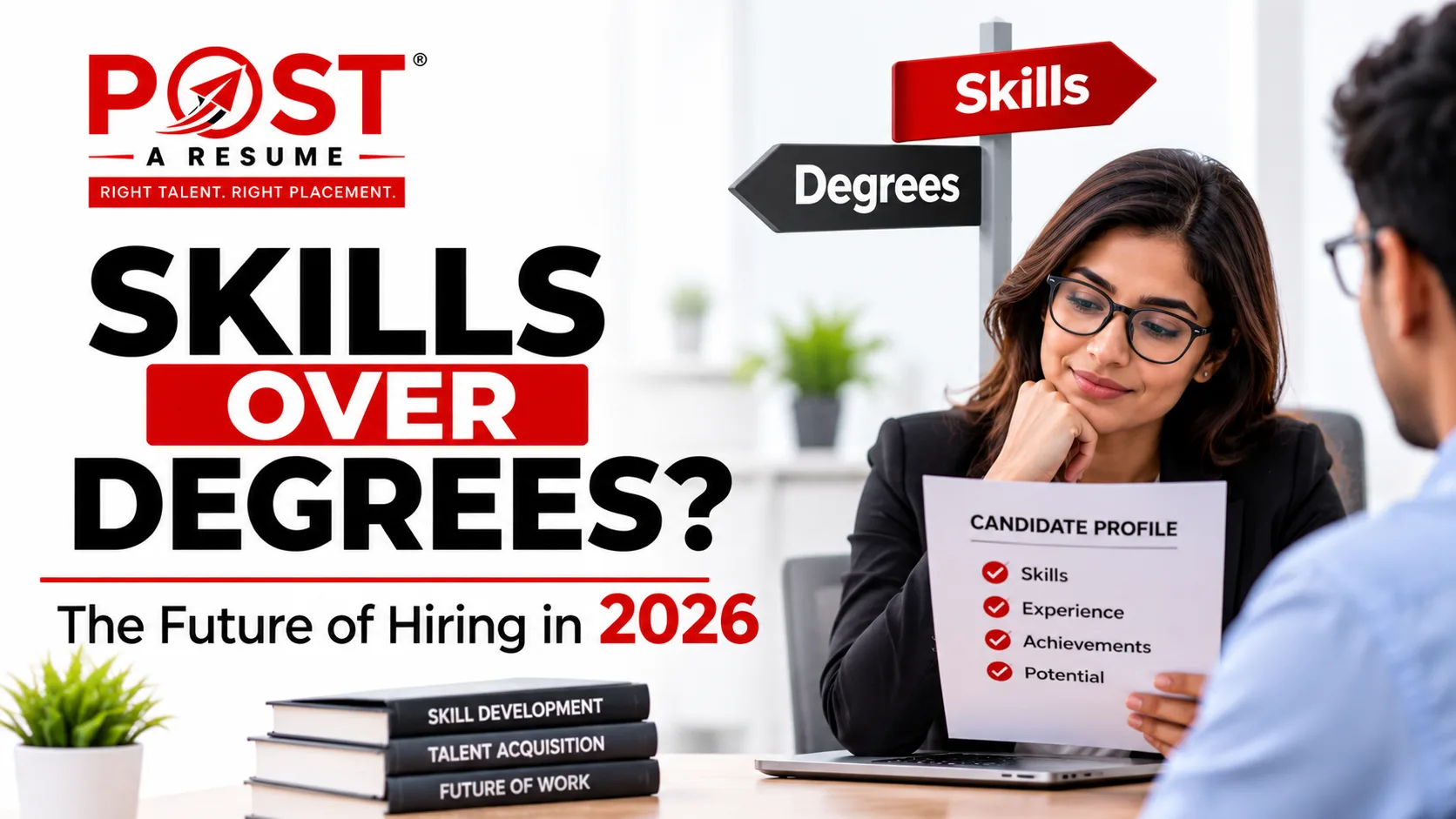
Skills-Based Hiring: Is Your Degree Still More Important Than Your Skills in 2026?
The recruitment landscape is changing. Employers are increasingly looking beyond academic qualifications to identify candidates who can demonstrate the skills needed to perform a job.
Skills-Based Hiring: Is Your Degree Still More Important Than Your Skills in 2026?
The recruitment landscape is changing. Employers are increasingly looking beyond academic qualifications to identify candidates who can demonstrate the skills needed to perform a job.
For decades, educational qualifications have played a major role in recruitment. A relevant degree, university reputation, and academic performance were often considered important indicators of a candidate's potential.
But the workplace is evolving.
Today, organisations need professionals who can solve problems, adapt to changing technologies, communicate effectively, and deliver measurable results. In many roles, possessing the right skills can be just as important as holding a particular degree.
This shift has brought skills-based hiring into the spotlight.
From technology and manufacturing to sales, marketing, engineering, and human resources, employers are increasingly exploring ways to evaluate candidates based on what they can actually do rather than relying exclusively on their educational background.
But does this mean degrees are becoming irrelevant? Not necessarily.
Let's understand what skills-based hiring means, why it is gaining popularity, and how it is changing the future of recruitment in 2026.
What Is Skills-Based Hiring?
Skills-based hiring is a recruitment approach in which employers prioritise a candidate's demonstrated abilities, practical knowledge, and job-related competencies when evaluating suitability for a position.
Instead of treating educational qualifications or previous job titles as the primary indicators of capability, recruiters assess whether candidates possess the skills required to perform the role successfully.
For example, consider an organisation hiring a Digital Marketing Executive.
A traditional hiring approach might prioritise candidates with a specific marketing degree and a particular number of years of experience.
A skills-based approach may also evaluate:
-
Practical knowledge of SEO and digital advertising.
-
Experience managing social media campaigns.
-
Understanding of Google Analytics and performance metrics.
-
Content creation and communication abilities.
-
Ability to analyse campaign results.
-
Practical project experience and demonstrated outcomes.
A candidate with a different educational background but strong relevant skills may also deserve consideration.
The objective is simple: Hire based on capability, not just credentials.
Why Is Skills-Based Hiring Becoming Important in 2026?
Several changes in the employment market are encouraging organisations to rethink traditional hiring criteria.
1. Rapidly Changing Industry Requirements
Technology, automation, artificial intelligence, and digital transformation are changing the skills required across industries.
New tools and technologies emerge faster than traditional academic programmes can always adapt.
Employers increasingly need professionals who can learn quickly, apply new knowledge, and adapt to changing business requirements.
This makes continuous learning and practical capabilities important considerations during recruitment.
2. The Growing Importance of Practical Experience
Academic knowledge provides a foundation, but employers also need candidates who can apply that knowledge in real workplace situations.
For example, an engineering graduate may understand theoretical concepts, but a manufacturing organisation may also need practical knowledge of production processes, quality control, machinery, and industrial safety.
Similarly, a finance graduate may understand accounting principles but still need practical experience with ERP systems, financial reporting, and compliance processes.
The ability to apply knowledge is becoming an important part of candidate evaluation.
3. Expanding the Talent Pool
Strict educational requirements can sometimes exclude candidates who possess relevant capabilities but have followed non-traditional career paths.
Skills-based hiring allows organisations to consider professionals with different educational backgrounds, career transitions, certifications, vocational training, and practical experience.
This can help employers discover talent that conventional screening methods might overlook.
4. Changing Employee and Employer Expectations
Today's professionals have access to multiple learning opportunities, including online certifications, industry training, professional communities, and practical projects.
As a result, skills can be developed through different pathways.
Employers are also recognising that a candidate's ability to learn, adapt, and solve problems can be valuable beyond their existing qualifications.
Degree-Based Hiring vs Skills-Based Hiring
Both approaches have a role in recruitment, but they evaluate candidates differently.
Degree-based hiring typically focuses on:
-
Educational qualifications.
-
Academic specialisation.
-
University or institution.
-
Academic performance.
-
Formal eligibility criteria.
Skills-based hiring typically focuses on:
-
Practical job-related capabilities.
-
Technical and functional knowledge.
-
Problem-solving ability.
-
Demonstrated achievements.
-
Relevant projects and assessments.
-
Adaptability and continuous learning.
This does not mean organisations should stop considering degrees.
For professions such as medicine, law, and certain engineering or regulated positions, specific educational qualifications, licences, and certifications remain essential.
The objective is to avoid unnecessary qualification requirements when they do not genuinely contribute to successful job performance.
5 Skills Employers Are Looking For in 2026
While technical requirements differ across industries, several transferable skills are becoming increasingly valuable.
1. Digital Literacy and AI Adaptability
Employees across different functions are increasingly expected to understand digital tools and work effectively with technology.
Basic AI literacy, data interpretation, and the ability to adapt to new software can provide an advantage in many professional roles.
2. Problem-Solving and Critical Thinking
Employers value professionals who can identify problems, evaluate possible solutions, and make informed decisions.
Rather than simply following instructions, employees should be capable of understanding challenges and taking appropriate action.
3. Communication Skills
Strong communication remains essential across almost every industry.
Whether dealing with customers, colleagues, vendors, or senior management, professionals must be able to communicate information clearly and effectively.
4. Adaptability and Learning Agility
Workplace requirements continue to evolve.
Candidates who demonstrate curiosity, willingness to learn, and the ability to adapt to changing responsibilities can be valuable additions to an organisation.
5. Collaboration and Emotional Intelligence
Technical expertise alone does not guarantee workplace success.
The ability to work with different personalities, manage disagreements, understand perspectives, and contribute to team objectives is equally important.
How Recruiters Can Implement Skills-Based Hiring
Moving towards skills-based recruitment requires more than removing degree requirements from job descriptions.
Recruiters and HR professionals need a structured approach to identify, evaluate, and compare candidates fairly.
Here are five practical steps.
Step 1: Identify the Actual Skills Required
Before publishing a vacancy, hiring managers should identify the essential competencies needed to perform the job.
Separate mandatory qualifications from preferences and distinguish between essential technical skills and desirable additional capabilities.
Step 2: Write Skills-Focused Job Descriptions
Job descriptions should clearly communicate the responsibilities, technical requirements, and competencies expected from candidates.
Avoid including educational qualifications or years of experience simply because they appeared in previous versions of the job description.
Every requirement should have a clear connection to the role.
Step 3: Use Practical Assessments
Where appropriate, recruiters can introduce job-related assessments to evaluate actual capabilities.
Examples include:
-
Technical assignments for software developers.
-
Design portfolios for creative professionals.
-
Sales simulations for business development roles.
-
Practical troubleshooting exercises for technical positions.
-
Case studies for management and consulting roles.
Assessments should be relevant, proportionate, and consistent across candidates.
Step 4: Evaluate Transferable Skills
Candidates may possess relevant skills developed outside their previous job titles or academic specialisations.
For example, a professional moving from customer service into sales may already have communication, negotiation, relationship management, and problem-solving abilities.
Recruiters should look beyond job titles to identify transferable capabilities.
Step 5: Standardise Candidate Evaluation
Structured interviews and consistent assessment criteria can help recruiters compare candidates more objectively.
Every candidate should be evaluated against relevant job requirements rather than subjective impressions or assumptions about their educational background.
Challenges of Skills-Based Hiring
Despite its advantages, implementing skills-based recruitment is not always straightforward.
Difficulty in Measuring Skills
Some capabilities, particularly communication, leadership, and problem-solving, can be difficult to measure accurately.
Organisations need appropriate assessment methods and clearly defined evaluation criteria.
Hiring Manager Resistance
Some hiring managers continue to prefer traditional qualifications and familiar career paths.
Changing this mindset requires demonstrating how relevant skills can contribute to actual job performance.
Time and Assessment Costs
Practical assessments, structured interviews, and skill evaluations require planning and resources.
Organisations must ensure that assessment processes are efficient and do not unnecessarily delay hiring.
Risk of Overlooking Industry Requirements
Not every position can be filled based on skills alone.
Certain roles require specific degrees, professional licences, certifications, or regulatory qualifications.
Recruiters must understand which requirements are essential and which can be flexible.
What Does Skills-Based Hiring Mean for Job Seekers?
The shift towards skills-based hiring also creates opportunities for candidates.
Job seekers should not depend entirely on their educational qualifications or previous job titles to demonstrate their professional value.
Instead, they should focus on presenting evidence of their capabilities.
Here are some practical suggestions:
-
Highlight relevant skills prominently on your resume.
-
Include measurable achievements wherever possible.
-
Showcase projects, portfolios, and practical assignments.
-
Mention relevant certifications and professional training.
-
Demonstrate how you have applied your knowledge in real situations.
-
Develop digital literacy and industry-relevant technical skills.
-
Prepare examples that demonstrate problem-solving and adaptability.
For fresh graduates, internships, academic projects, volunteering, and independent work can help demonstrate practical capabilities.
For experienced professionals, measurable achievements and examples of increasing responsibilities can strengthen their profiles.
Your qualifications may introduce you to an employer, but your ability to demonstrate relevant skills can help establish your suitability for the role.
The Future of Recruitment: Will Skills Replace Degrees?
The future of recruitment is unlikely to be defined by a complete shift from qualifications to skills.
Instead, organisations will increasingly need a balanced approach.
Educational qualifications provide foundational knowledge and remain essential for many specialised and regulated professions. Practical skills demonstrate whether candidates can apply that knowledge effectively.
Experience provides additional context about how individuals have performed in professional environments.
The strongest hiring decisions consider all three.
Recruitment teams must also recognise the importance of attitude, adaptability, cultural contribution, and long-term potential.
The objective should not be to hire candidates with the longest list of skills. It should be to identify individuals whose capabilities align with the actual requirements of the organisation.
Final Thoughts: Hire for Capability, Not Just Credentials
The traditional recruitment model is evolving.
As industries change and workplace requirements become more dynamic, organisations need to rethink how they identify and evaluate talent.
Skills-based hiring offers an opportunity to widen talent pools, recognise practical capabilities, and create more relevant selection processes.
However, qualifications still matter where they are genuinely required. The real challenge is finding the right balance between academic knowledge, professional experience, and demonstrated skills.
For recruiters and employers, the question should no longer be limited to where a candidate studied or what their previous job title was.
It should also be:
What can this candidate actually bring to the organisation?
Because successful hiring is not simply about finding someone who meets the criteria on paper. It is about identifying someone who can contribute, grow, and create value.
What Do You Think?
Should companies prioritise practical skills over educational qualifications when hiring, or do you believe degrees should remain an essential selection criterion?
Share your thoughts in the comments.
Follow Post A Resume for more insights on recruitment trends, talent acquisition, HR practices, and career development.
Connect with Post A Resume:
-
Website: https://postaresume.co.in/
-
Instagram: https://www.instagram.com/postaresume2/