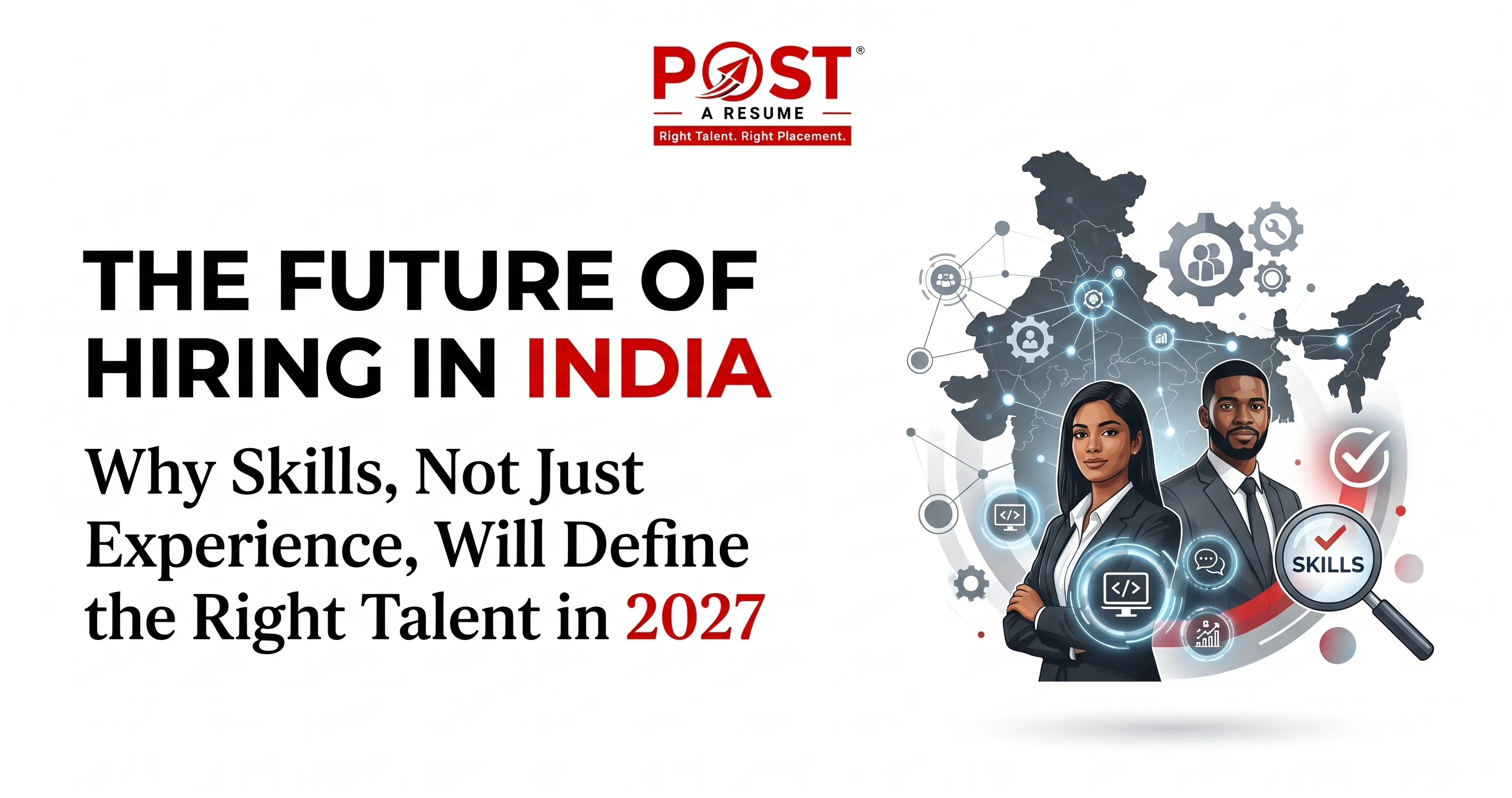
The Future of Hiring in India: Why Skills, Not Just Experience, Will Define the Right Talent in 2027
The recruitment landscape in India is changing. As artificial intelligence, evolving business requirements, and specialised skills reshape industries, employers must rethink how they identify and hire the right talent.
For years, recruitment decisions were heavily influenced by educational qualifications, years of experience, previous job titles, and the companies listed on a candidate's resume.
A candidate with ten years of experience was often considered more valuable than someone with five years of relevant expertise. Similarly, educational qualifications and previous designations frequently influenced shortlisting decisions.
But is that still enough?
As businesses enter 2027, the expectations from employees are changing. Organisations need professionals who can adapt to new technologies, solve business problems, manage responsibilities, and deliver measurable results.
Artificial intelligence is changing how recruiters identify candidates. Skills-based hiring is challenging traditional recruitment practices. Meanwhile, industries such as manufacturing, pharmaceuticals, engineering, IT, and textiles are looking for professionals with increasingly specialised expertise.
The question for employers is no longer simply how quickly they can fill a vacancy.
It is whether they are hiring the right talent for their organisation's future.
Let's explore the major recruitment trends shaping the future of hiring in India and what employers should consider when building their teams in 2027.
1. The Changing Recruitment Landscape in India
India's employment market is becoming increasingly competitive, with organisations looking for professionals who can contribute beyond the basic requirements of a job description.
Traditional recruitment methods often relied on educational qualifications, years of experience, and keyword-based resume screening.
While these factors remain relevant, they do not always provide a complete picture of a candidate's capabilities.
According to recruitment trends highlighted in 2026 industry reports:
-
Skills-based hiring: ETHRWorld has highlighted that 39% of Indian hiring managers are prioritising skills over education or career history.
-
AI in recruitment: Deloitte reports that 86% of surveyed organisations say AI or Agentic AI is transforming recruitment processes.
-
Demand for specialised talent: Employers are increasingly focusing on niche skills, AI readiness, and quality of hiring.
-
Industry-specific hiring: PeopleLogic reported that manufacturing and pharmaceutical sectors together accounted for 49.1% of job postings in September 2026.
These developments indicate a broader shift in recruitment priorities.
Employers are looking beyond traditional qualifications and focusing more on what candidates can actually contribute.
For recruitment teams, this means understanding the role, evaluating relevant competencies, and identifying professionals whose experience aligns with the organisation's business objectives.
2. Skills vs Experience vs Qualifications: What Should Employers Prioritise?
One of the biggest challenges in recruitment is determining what makes a candidate genuinely suitable for a position.
Should employers prioritise qualifications, experience, or practical skills?
The answer depends on the role, industry, and responsibilities involved.
Educational Qualifications
Educational qualifications provide a foundation of theoretical knowledge and demonstrate formal learning.
For specialised professions such as medicine, engineering, finance, and certain technical positions, relevant qualifications and professional certifications remain important.
However, a degree alone cannot always establish whether someone can perform effectively in a real workplace.
Professional Experience
Experience helps recruiters understand a candidate's exposure to responsibilities, industries, projects, and workplace challenges.
However, years of experience should not automatically be treated as an indicator of competence.
A candidate with eight years of experience may have performed similar responsibilities throughout their career, while someone with five years of experience may have handled more complex assignments and demonstrated stronger capabilities.
The quality and relevance of experience matter as much as its duration.
Practical Skills
Skills demonstrate what a candidate can actually do.
For example, an organisation hiring a Production Manager may need someone with knowledge of production planning, team management, quality control, process improvement, and operational efficiency.
A candidate's ability to demonstrate these competencies can be more valuable than simply having an impressive job title.
What Should Employers Evaluate?
A balanced recruitment approach should consider:
-
Educational qualifications relevant to the position.
-
Practical and technical competencies.
-
Quality and relevance of professional experience.
-
Problem-solving and decision-making abilities.
-
Communication and leadership capabilities.
-
Adaptability and willingness to learn.
-
Demonstrated achievements and responsibilities.
The right hiring decision comes from evaluating the complete candidate profile rather than relying on a single qualification or experience metric.
3. The Role of AI in Modern Recruitment
Artificial intelligence is becoming an important part of modern talent acquisition.
Recruitment teams are exploring AI-powered tools to streamline repetitive activities, improve candidate sourcing, and manage large volumes of applications.
Some of the major applications include:
AI-Powered Resume Screening
AI-assisted recruitment systems can help identify relevant skills, experience, and qualifications from large numbers of applications.
This can reduce manual screening efforts and help recruiters organise candidate profiles more efficiently.
However, automated screening should not become the sole basis for rejecting candidates. Systems can overlook relevant experience, misunderstand context, or reproduce biases present in historical hiring data.
Intelligent Candidate Sourcing
AI tools can help recruiters search candidate databases and identify professionals with specific combinations of skills, industry exposure, and experience.
This can be particularly useful for niche and senior-level positions where finding suitable talent requires a more targeted search.
Automated Recruitment Communication
Recruitment automation can support application acknowledgements, interview reminders, scheduling, and routine candidate updates.
This helps recruiters reduce administrative work and spend more time on candidate engagement.
Recruitment Analytics
AI-supported analytics can help organisations understand recruitment performance through metrics such as time to hire, sourcing effectiveness, offer acceptance rates, and recruitment costs.
These insights can support better hiring decisions and process improvements.
Why Human Judgement Still Matters
Despite these developments, recruitment remains a people-driven function.
AI cannot independently understand every aspect of a candidate's career journey, motivations, expectations, leadership potential, or suitability for a particular business environment.
A recruitment system may identify a candidate with matching keywords, but a recruiter must determine whether the person's actual experience meets the employer's requirements.
The future of recruitment is not AI replacing recruiters. It is recruiters using technology to make better-informed hiring decisions.
4. The Growing Demand for Specialised Talent in India
As Indian industries evolve, organisations increasingly need professionals with specific technical knowledge, functional expertise, and industry experience.
Generic recruitment approaches may not always work when hiring for specialised positions.
Different industries have different talent requirements.
Manufacturing and Engineering
Manufacturing organisations require professionals who understand production operations, quality management, industrial processes, maintenance, and supply chain coordination.
Some frequently sought-after areas of expertise include:
-
Production and Plant Management.
-
Quality Assurance and Quality Control.
-
Mechanical and Electrical Engineering.
-
Industrial Automation.
-
Maintenance and Operations.
-
Supply Chain and Procurement.
-
Project Management.
Employers often need candidates who combine technical knowledge with practical exposure to industrial environments.
Pharmaceutical Industry
The pharmaceutical sector requires professionals with specialised knowledge of manufacturing processes, regulatory compliance, quality systems, and product development.
Important recruitment areas include:
-
Quality Assurance and Quality Control.
-
Regulatory Affairs.
-
Pharmaceutical Production.
-
Research and Development.
-
Validation and Documentation.
-
Pharmaceutical Sales and Marketing.
Industry-specific knowledge and familiarity with regulatory requirements can be critical selection factors.
Information Technology
The IT sector continues to evolve with developments in artificial intelligence, cybersecurity, cloud computing, software development, and data analytics.
Employers increasingly seek professionals who can work with changing technologies and apply their knowledge to real business requirements.
Textile Industry
India's textile industry requires professionals across production, merchandising, quality control, sourcing, export management, and operations.
Experience with manufacturing processes, fabric knowledge, international markets, and supply chain management can be particularly relevant for specialised positions.
Why Industry Knowledge Matters
Recruiting for a specialised role requires more than matching a resume against a job description.
Recruiters must understand the industry, technical terminology, actual responsibilities, and the difference between similar job titles.
For example, two candidates may both have the designation of Production Manager, but their experience could differ significantly depending on the manufacturing process, plant size, product category, and operational responsibilities.
Understanding these differences is essential to identifying the right talent.
5. Why Hiring the Right Senior Talent Matters
As organisations expand, hiring decisions become increasingly important.
While entry-level recruitment focuses largely on foundational capabilities and learning potential, senior-level hiring often involves responsibilities that directly influence business performance.
A wrong leadership appointment can affect team productivity, operational efficiency, employee retention, and business growth.
This makes executive and mid-senior recruitment particularly important.
Leadership Hiring Requires More Than Experience
A candidate may have an impressive professional background, but that does not automatically make them the right leader for every organisation.
Employers should evaluate:
-
Leadership and people management capabilities.
-
Strategic thinking and decision-making.
-
Financial and operational understanding.
-
Industry knowledge.
-
Change management experience.
-
Ability to build and develop teams.
-
Alignment with organisational objectives.
The Cost of a Wrong Hiring Decision
An unsuitable senior-level appointment can result in significant indirect costs.
These may include:
-
Lost productivity.
-
Delayed business objectives.
-
Team restructuring.
-
Increased employee turnover.
-
Additional recruitment expenses.
-
Disruption to ongoing operations.
The impact can extend beyond the cost of recruitment itself.
For this reason, senior hiring should involve structured evaluation, detailed discussions, reference checks, and a clear understanding of the organisation's expectations.
The objective is not simply to hire an experienced professional. It is to identify a leader who can create value for the business.
6. How Recruitment Consultants Add Value to Modern Hiring
As recruitment requirements become more specialised, businesses may find it challenging to manage every hiring requirement internally.
This is where experienced recruitment consultants can add value.
A recruitment consultant does more than collect resumes and forward candidate profiles.
A structured recruitment process involves understanding the employer's requirements, identifying suitable talent, evaluating candidates, and supporting communication throughout the hiring process.
Understanding the Employer's Requirements
Effective recruitment begins with understanding the position.
This includes responsibilities, reporting structure, technical requirements, industry exposure, compensation expectations, location, and other important hiring considerations.
A clear understanding of the requirement helps avoid irrelevant applications and unnecessary delays.
Access to Relevant Talent Networks
Recruitment consultants can leverage candidate databases, professional networks, referrals, and targeted sourcing strategies to identify potential candidates.
This is particularly useful for niche positions and specialised hiring requirements.
Candidate Evaluation and Shortlisting
Recruitment consultants can assess candidate profiles against the employer's requirements and identify relevant experience, skills, and career progression.
Structured evaluation helps hiring managers focus their attention on candidates who merit further consideration.
Managing the Recruitment Process
Recruitment involves multiple stages, including candidate communication, interview coordination, feedback collection, salary discussions, and offer follow-ups.
Professional recruitment support can help employers manage these activities more systematically.
Supporting India and International Hiring
Businesses expanding into new markets may require access to talent across different locations and countries.
Recruitment consultants with relevant market exposure can support these requirements by identifying professionals whose experience aligns with the employer's geographical and industry needs.
Ultimately, recruitment consultancy adds value by helping businesses improve the quality and relevance of their hiring process.
7. What Employers Should Do Differently in 2027
The changing recruitment landscape requires organisations to review how they attract, assess, and select talent.
Here are seven practical recommendations for employers and HR leaders.
1. Review job descriptions regularly.
Ensure that job descriptions reflect actual business requirements rather than outdated responsibilities or unnecessary qualifications.
2. Prioritise relevant skills.
Evaluate candidates based on practical capabilities and their relevance to the position.
3. Adopt technology thoughtfully.
Use AI and recruitment automation to improve efficiency, while maintaining human oversight in candidate evaluation and selection.
4. Strengthen employer branding.
Communicate organisational culture, career opportunities, expectations, and professional development opportunities clearly.
5. Improve candidate experience.
Maintain transparent communication, timely feedback, and a professional interview process.
6. Invest in specialised and leadership hiring.
Recognise that critical positions require a deeper understanding of industry requirements and candidate capabilities.
7. Measure quality of hire.
Look beyond the number of vacancies filled. Evaluate how effectively new employees contribute to their teams and organisational objectives over time.
The future of hiring will reward organisations that focus on recruitment quality rather than simply recruitment volume.
The Future of Hiring in India: A More Strategic Approach to Talent Acquisition
India's recruitment landscape is moving towards a more skills-focused, technology-enabled, and specialised approach.
Educational qualifications and professional experience will continue to matter, but they will increasingly be considered alongside practical competencies, adaptability, industry knowledge, and the ability to deliver results.
Artificial intelligence will help recruiters improve efficiency and manage information. Skills-based hiring will encourage employers to evaluate candidates more comprehensively. Specialised talent acquisition will become increasingly important as businesses respond to changing market requirements.
However, one principle will remain unchanged.
Successful businesses need the right people in the right positions.
Technology can improve the recruitment process, but identifying the right talent still requires industry understanding, professional judgement, and meaningful human interaction.
For employers, the challenge in 2027 will not simply be finding available candidates. It will be identifying professionals who can contribute to the organisation's present requirements while supporting its future growth.
How Post A Resume Supports Businesses in Finding the Right Talent
At Post A Resume, we believe effective recruitment begins with understanding the employer's requirements and identifying professionals whose experience and capabilities align with the role.
As a recruitment firm serving India and international markets since 2007, Post A Resume supports organisations with recruitment requirements across industries and professional functions.
Our approach focuses on understanding hiring needs, identifying relevant candidates, evaluating professional experience, and supporting the recruitment process.
Whether a business is hiring for a specialised technical position, a mid-senior management role, or an executive-level requirement, finding the right talent requires a focused and structured approach.
Because recruitment is not just about filling vacancies. It is about helping businesses build teams that can move them forward.
Looking for the right talent for your organisation?
Connect with Post A Resume to discuss your recruitment requirements.
Website: https://postaresume.co.in/
Connect with us:
-
Instagram: https://www.instagram.com/postaresume2/
Final Thoughts
The future of hiring in India will be shaped by changing skill requirements, artificial intelligence, specialised industry knowledge, and a greater emphasis on recruitment quality.
Employers who continue to rely exclusively on traditional hiring criteria may overlook professionals with the capabilities their businesses actually need.
The next phase of recruitment will require a more balanced approach, one that considers qualifications, experience, skills, adaptability, and potential.
As we move towards 2027, the most important question for every employer should be:
Are we hiring someone who simply matches the job description, or someone who can genuinely contribute to the future of our business?
The difference between the two can define the quality of an organisation's talent and its ability to grow.
- Post A Resume
Post A Resume